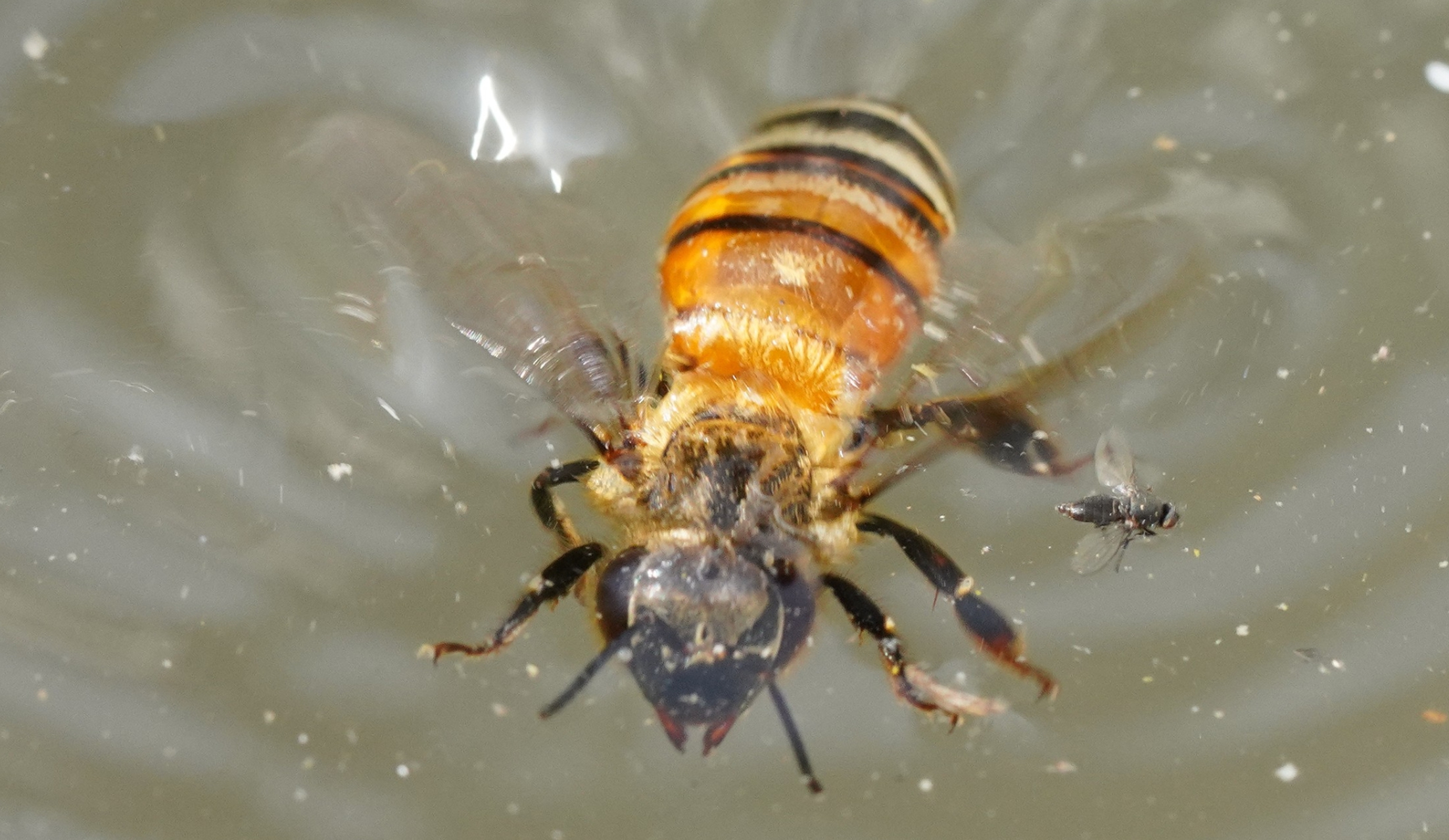
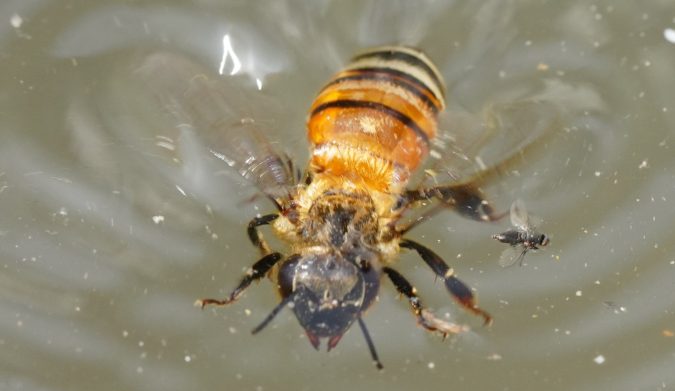
When a honeybee lands on water, it doesn’t just float—it generates surface waves to propel itself forward, a behavior described in 2019 and sometimes called “hydrofoiling.”
But movement alone isn’t enough. Where a bee goes—and whether it escapes—depends on more than just mechanics.
In our new study (Communications Biology, 2026), we asked a simple question: what do bees actually do when they are stranded on water?
We found that their movement is not random. Bees tend to orient and move toward darker regions, suggesting that they use visual cues to guide their escape. Rather than drifting aimlessly, they appear to actively navigate across the surface.
This adds an ecological layer to earlier work on the mechanics of movement. It suggests that successful escape depends not only on the ability to generate propulsion, but also on the ability to control direction.
However, this behavior is fragile.
When bees were exposed to the neonicotinoid pesticide thiamethoxam, their movement became less coordinated. They were less able to maintain controlled motion across the surface, which could reduce their chances of reaching safety.
Water is a common but often overlooked hazard for pollinators. Bees encounter it while foraging, drinking, or navigating complex environments. The ability to move and orient on the water surface may therefore be more important for survival than previously appreciated.
Our findings suggest that this ability—combining propulsion, control, and navigation—can be disrupted by environmental stressors. In this case, exposure to a widely used pesticide impaired the coordination required for effective escape.
If you’ve ever seen a bee struggling on water, it may not simply be drifting. It may be trying to navigate its way to safety—and that effort can succeed or fail depending on how well it can control its movement.
This study was also featured by MSU News.