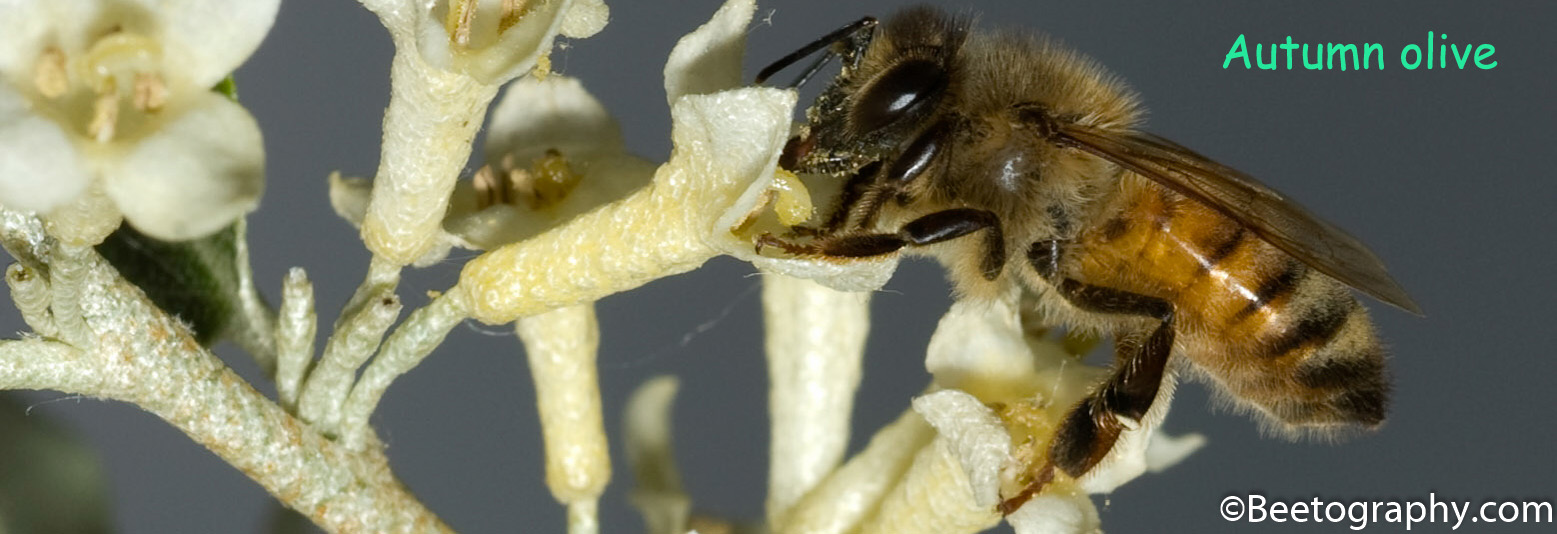
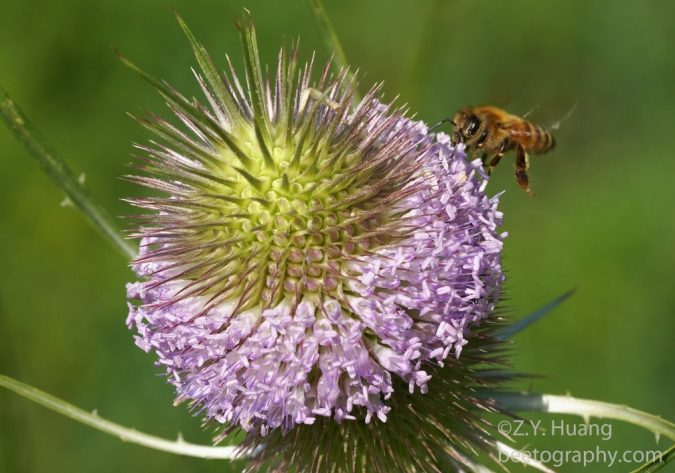
A common honey bee parasite may do more than make bees sick—it can interfere with the hormonal system that determines when young workers leave the hive and begin the dangerous job of foraging.
In a new study published in Biology Open, Huarong Lin, Joseph Sullivan, Thomas Webster and Zachary Huang investigated how infection with the microscopic parasite Nosema apis changes honey bee behavior and physiology. The work involved researchers from Michigan State University, and Kentucky State University, with Huang at MSU serving as the corresponding author.
The researchers confirmed that infected worker bees began foraging significantly earlier than healthy bees and tried to determine the mechanisms underlying this. They traced this change to juvenile hormone (JH), one of the major hormones controlling the normal transition from working inside the hive to collecting food outside. Infected bees had about 1.7 times more juvenile hormone in their blood, while the glands that produce the hormone increased production by about 83%.
The strongest evidence came from an experiment in which researchers surgically removed the tiny glands—the corpora allata—that produce juvenile hormone. After the glands were removed, infection no longer significantly accelerated foraging. Together with the hormone measurements, this provides evidence that Nosema changes behavior at least partly by altering the bee’s own endocrine system. Interestingly, infected bees also showed increased JH degradation, indicating increased JH turnover: infected bees both produced and degraded more JH, yet still maintained higher JH levels in their blood.
For beekeepers, the finding helps explain why Nosema infection can have consequences beyond the health of individual bees. A honey bee colony depends on an orderly division of labor: younger workers normally perform jobs inside the hive before becoming foragers. Pushing workers into foraging prematurely could shorten their productive lives and disrupt the colony’s workforce.
The study also illustrates a broader biological lesson. Parasites do not necessarily affect their hosts simply by damaging tissues or stealing nutrients. They can alter the physiological systems that control behavior. In a highly social animal such as the honey bee, changing when individual workers change jobs could ultimately influence how the entire colony functions.
Huarong LinJoseph SullivanThomas C. WebsterZachary Y. Huang; Altered juvenile hormone dynamics mediate earlier foraging in Nosema-infected honey bees. Biol Open 15 September 2026; 15 (9): bio062830. doi: https://doi.org/10.1242/bio.062830
